by Joe Lombardo, published on his Facebook Page, January 24, 2026
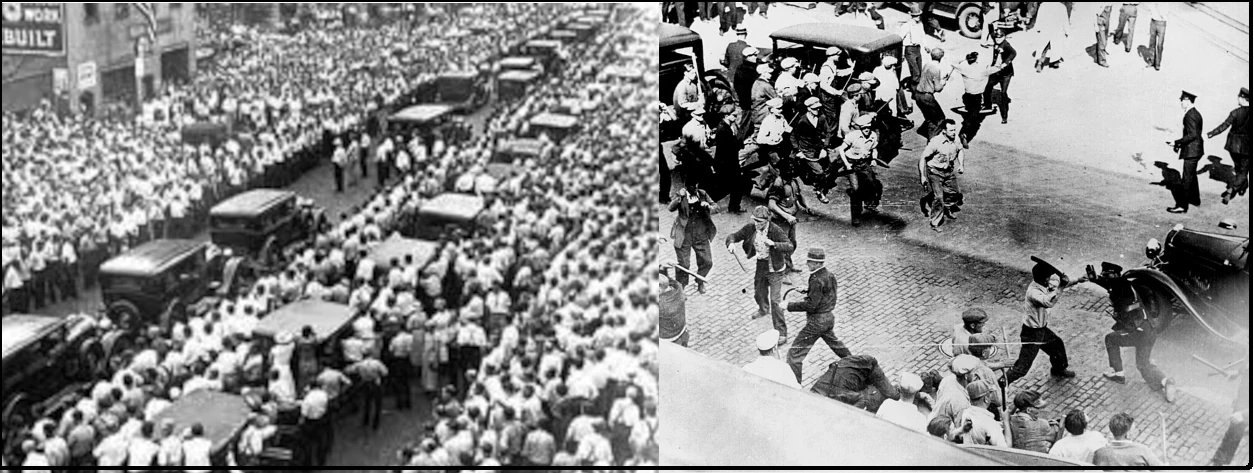
Yesterday we saw tens of thousands of people march and rally in Minneapolis in -9 degree temperature. Schools and workplaces shutdown in what was termed a general strike against the racist ICE raids on their community and the murder of Renee Good. Yesterday, I heard a commentator say this was the first general strike in US history. This, of course, is not true and it is a dangerous re-writing of history.
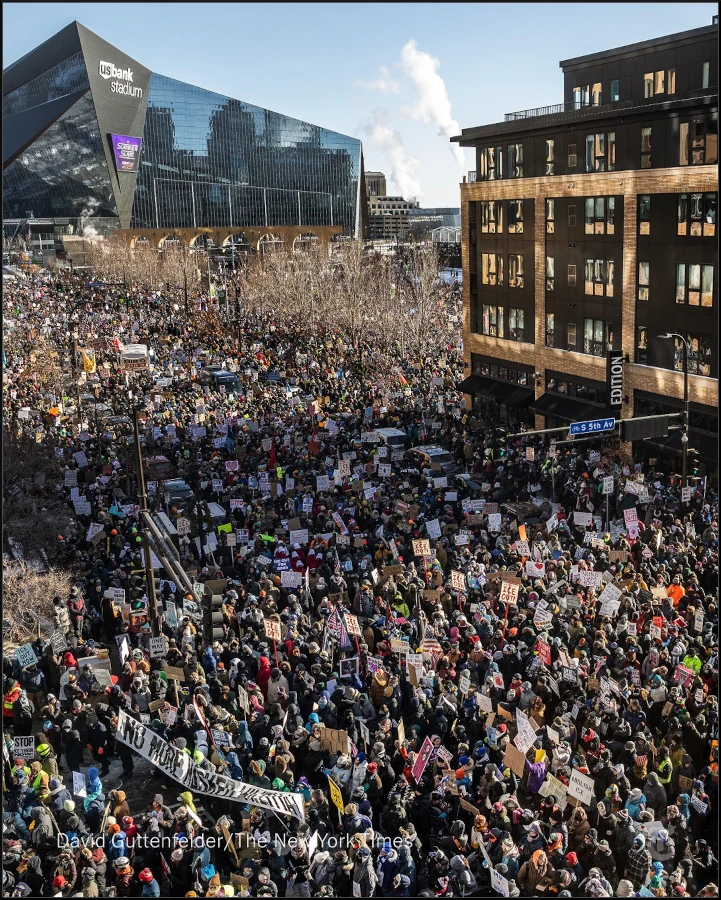
With the rise of labor during the 1930’s there were general strikes in San Francisco, Detroit, Toledo, OH and elsewhere including a well-known general strike in Minneapolis in 1934 which grew out of a strike by Teamsters against the trucking companies. This Teamster rebellion and general strike led to Minneapolis turning into a union city and led to the building of the Teamsters union into one of the strongest unions throughout the country. The entire state of Minnesota was moved in a progressive direction that continues until today and is reflected in the fightback that we are seeing in Minneapolis against ICE, for the immigrant community and against the government’s move towards fascism.
This is even reflected in the Democratic Party in the state of Minnesota. In Minnesota the Democratic Party is not called the Democratic Party it is called the Minnesota Democratic-Farmer-Labor Party due to a merger of the Democratic Party and the Farmer-Labor Party of Minnesota in 1944. The Farmer-Labor Party had come from the movement of radical workers and Farmers, starting in 1917, at the time of the Russian Revolution and during a period of radicalization throughout the world.
This fightback spirit in Minneapolis was also reflected in the protests over the murder of George Floyd who was killed not far from the place where Renee Good was murdered by an unhinged ICE agent. The protest over the murder of George Floyd ignited a movement that included some of the largest series of protests that the country has ever seen.
In a very real sense, Minneapolis has played an important role in the development of the movement for progressive change in the US. Not so coincidentally, Trump has made it the target of his movement towards fascism and the people of Minneapolis are fighting back. We must all get behind them.
What happened in 1934 in Minneapolis?
Prior to 1934, Minneapolis was a non-union city. Led by a right-wing group in business owners called the Citizens Alliance, no union could get much of a foothold in Minneapolis. At the time, the governor of the state was a man named Floyd Olson, a member of the Farmer-Labor Party whose members were supportive of unionization. Despite this, when the city was taken over by the workers, he called in the National Guard.
In 1934, there were only 75 workers in Local 574 of the Teamsters union in Minneapolis when members of a small group of socialists called the Communist League of America started organizing in the local for better wages and working conditions. To get their demands, they ignored the threats of the bosses and the conservatism of the national leadership of the Teamsters and conducted a successful strike. Because of this, the Local 574 won the respect of workers throughout the city and they went on an organizing effort that brought around 3,000 drivers, helpers and warehouse workers into the union.
With this large influx of workers into the union, they presented demands to all the trucking firms. They wanted a closed shop, shorter hours and standardized pay for all workers. They understood the bosses would refuse so they prepared for a strike by renting a large hall, setting it up with a kitchen to feed workers who might need to strike for their demands and approaching organizations of farmers and the unemployed to support their efforts. In past labor actions, the unemployed were used as scabs to break strikes of workers but in May 1934 when the Minneapolis workers took to the streets and shut down the city, the unemployed were among the most militant people on the picket lines and the farmers provided the workers with food.
Police and private security tried to break the strike and beat the picketing workers. The Central Labor Council in Minneapolis offered the workers financial support and the Building Trade workers began a sympathy strike with the Teamsters. Fighting between the police with their private security and the workers continued and during a battle called the “Battle of Deputies’ Run” the workers routed the police and private security and chased them from the main market area of the city where the workers headquarters was located.
Pickets were set up on roads leading into the city and all trucks other than those with permits from the workers were prevented from entering the city.
At one point, the police opened fire on the striking workers and two men, Henry Ness and John Belor were killed and many others were wounded. The funeral for the men turned into a mass demonstration and an estimated 100,000 people turned out. There were calls for the mayor and the police chief to be impeached. The bosses continued to try and break the strike but the scab trucks they tried to bring into the city were met by crowds of people and picketers and most could not enter the city.
On July 25, mediators issued a proposal for a minimum wage and recognition of the union for drivers, helpers and inside workers. The bosses rejected the offer and the strike continued. The union called on the Central Labor Council to call for a general strike throughout the city. Governor Olsen sent the national guard to the city to try and break the strike despite the fact that members of his Farmer-Labor Party supported it. The national guard allowed trucks not approved by the union to enter the city, but only trucks from companies that agreed to the mediator’s proposal.
On August 21, federal mediators got agreement from the head of the Citizens Alliance to support the major demands of the union.
The Minneapolis general strike changed the city from an open shop city to a union city. In the months following the strike, Teamsters Local 574 helped organize thousands of workers throughout the city, from many industries, into unions and Minneapolis became a union city and along with other areas where there were general strikes in the country it gave impetus to industrial unionism in the US and the organization of the Congress of Industrial Organizations (CIO), which organized all trades within an industry.
This is an important part of the heritage of Minneapolis that can be seen in the resistance to ICE today. It is a part of the history of the city and the US working class that you will not learn in the schools and the “acceptable” history books. But now you know it and can use it in the battles ahead.
Joe Lombardo is a life long peace activist and union organizer. He is a co-founder of the United National Antiwar Coalition (UNAC) and a member of the Administrative Committee.