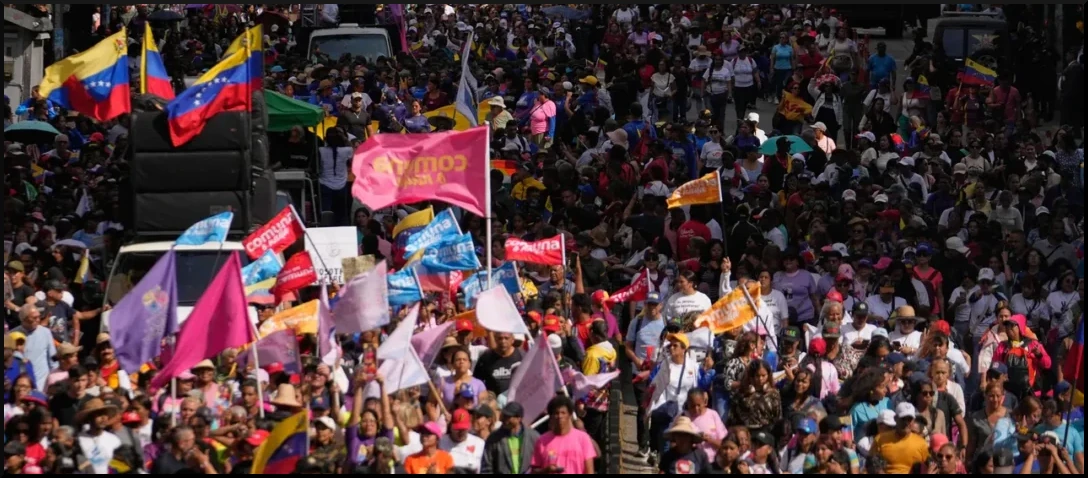
by Sara Flounders, published on Workers World, January 14, 2026
January 11. It’s now eight days since U.S. gangsters kidnapped Venezuelan President Nicolás Maduro and First Revolutionary Combatant and former President of the Venezuelan National Assembly Cilia Flores. It’s a month after the Dec. 6 White House release of its National Security Strategy document, with its so-called Trump Corollary to the Monroe Doctrine.
It is worth evaluating what these events represent for U.S. imperialist power and its ability to reverse Washington’s rapidly declining global position.
As an immediate task, all progressive forces must be mobilized to demand the freedom and return of Maduro and Flores and to defend Venezuelan sovereignty.
Evaluating the outrageous kidnapping of a head of state and the pompous National Security Strategy document requires a global perspective and an understanding of the increasing influence of people’s movements in shaping history. Revolutionary determination and morale are material factors in political struggles.
Limits of U.S. weapons
In a meeting between President Trump and top oil industry executives, President Donald Trump urged them to rush back into extracting Venezuela’s enormous oil reserves. This meeting exposes the limits of U.S. imperialism’s power. Even extreme actions cannot halt its irreversible decline.
Trump had promised that U.S. oil companies would invest $100 billion to rapidly rebuild Venezuela’s dilapidated oil industry infrastructure and increase oil production by millions of barrels. Almost every media outlet covered the oil companies’ reluctance to invest such a large sum. (Reuters, AP, PBS, BBC, NY Times, January 10, 2026)
The hesitation of Darren Woods, CEO of Exxon Mobil, which is the largest U.S. oil corporation, described the biggest hurdle: “We’ve had our assets there seized twice, and so you can imagine, to re-enter a third time would require some pretty significant changes. … Today [Venezuela] is uninvestible.”
This reflects the power and acknowledged strength of the Bolivarian Revolution. It has withstood 25 years of U.S. sanctions, assassinations, regime-change operations, asset seizures, tanker seizures and a massive, high-tech U.S. stealth invasion to kidnap President Maduro. The Bolivarian Revolution did not disintegrate. It maintained its organizational unity and political cohesion. Venezuelans have mobilized by the millions in the streets and in armed people’s militias.
Trump and the loyal corporate media tried to divide the Venezuelan elected officials with rumors and innuendos about sell-outs and inside deals. Instead U.S. strategists hit a solid wall of internal cohesion and revolutionary determination.
The Venezuelan leadership, like Presidents Hugo Chávez and Nicolás Maduro before them, maintains that they are willing to negotiate with the U.S. However, it was the U.S. that officially blocked all negotiations. Venezuela has always been willing to sell its oil to the U.S., but it was U.S. sanctions that blocked the oil sales. They are willing to reopen embassies. The U.S. ordered the embassies closed.
The problem for the U.S. is that Vice President Delcy Rodríguez and the core leadership of the United Socialist Party of Venezuela (PSUV) — including Minister of the Interior Diosdado Cabello and Minister of Defense Vladimir Padrino, as well as the armed forces and Peoples Militias — project a united front. Acting as interim leader, Rodríguez forcefully declared: “There is only one president in this country, and his name is Nicolás Maduro Moros. We will never again be a colony of any empire.”
U.S. militarism can’t expand oil corporation profits
The meeting with the oil companies’ executives came on the same day that the U.S. seized a fifth oil tanker.
Trump confidently asserted: “Our giant oil companies will be spending at least $100 billion of their money, not the government’s money. They don’t need government money. But they need government protection.” (AP, Jan. 9)
Trump bragged that the U.S. was immediately taking over the sale of 30 million to 50 million barrels of Venezuela’s sanctioned crude oil and would control sales of Venezuelan oil worldwide indefinitely. Reality check: 30 to 50 million barrels of stolen oil, now trading at $56 a barrel, is worth only $2.75 billion — or two-and-a-half days of U.S. needs. This is less than 3% of the $100 billion in required oil company investments. (pbs.org, Jan. 7)
Officials of the powerful oil monopolies made it clear they do not think the U.S. government can protect their resource theft or even guarantee their security in Venezuela for decades to come.
While U.S. corporation CEOs are all for a quick rip-off and quick profits, they are “risk averse.” They complain of high debt loads and growing demands for cleaner energy then point out that global oil markets are oversupplied and prices are hovering near five-year lows. Their reality of late stage capitalism is that they must maximize profit every quarter. Long term infrastructure investment reduces profits and payments to shareholders.
Venezuela is uninvestible
This declaration that Venezuela is “uninvestible” exposes the wishful thinking and grand, unrealistic projections of Trump’s Corollary to the Monroe Doctrine and the whole National Security Strategy document.
The 32-page document is based on the imperial arrogance of a world that existed 200 years ago. It is not based on the material reality of today’s world or an understanding of the global economy. The shrinking U.S. position is papered over with grandiose statements and absurd declarations of continued economic dominance.
The document’s focus reveals the shrinking U.S. global position. It’s a break from the 1992 Defense Planning Guidance focused on maintaining U.S. hegemony worldwide and the 1997 National Security Strategy for a New [American] Century. It is a retreat into what amounts to a desperate effort to lay claim to the Western Hemisphere.
The Trump Corollary asserts that the Trump Administration will “restore and enforce the 1823 Monroe Doctrine to restore American preeminence in the Western Hemisphere.” It arrogantly calls for the whole western hemisphere to decouple from China as the crucial step in restoring U.S. global dominance. (See National Security Strategy, for the full text )
Why the U.S. economy is shriveling
But how is this possible, considering China’s trade surplus of $1.08 trillion? The U.S. has a trade deficit of $52.8 billion, with no trade surpluses for the past 50 years.
The U.S. accounted for over 50% of world global production in 1950. According to the United Nations Industrial Development Organization (UNIDO), the U.S. will account for only 11% of world industrial production by 2030 while China will account for 45% of global industrial production.
This enormous industrial capacity is proving to be decisive, especially because China, as a formerly colonized country, is willing to share its technology and help other formerly colonized countries of the Global South in their development.
All the key industries in China are socially owned by the whole people, not a handful of billionaires. They can operate without being required to distribute dividends and increase profits each quarter. They are free to make long term infrastructure plans. This ability to plan accelerates development.
Every page of the National Security Strategy reflects the view that every other country’s productive capacity is seen as a threat. U.S. strategy focuses on using coercive diplomacy or gunboat diplomacy, including raising tariffs and increasing strangling sanctions.
The NSS declares: “The United States must be preeminent in the Western Hemisphere as a condition of our security and prosperity.” This is an unappealing alternative to China’s economic engagement strategy, considering the scale of China’s trade and China’s willingness to invest in infrastructure.
China is now South America’s largest trading partner. Trade between China, Latin America and the Caribbean soared from $12 billion in 2000 to $315 billion in 2020, according to a report in the Feb. 24, 2025, America’s Quarterly. It grew in 2024 to a record high of over $518 billion.
China’s decades-long strategy involves building long-term relationships through diplomacy and the Belt and Road Initiative (BRI), which 21 Latin American and Caribbean countries had joined as of 2024.
Big U.S. investors are unconvinced that by holding a kidnapped president in a New York City prison the White House has improved the global economic position of the U.S. The U.S. economy can’t offer the kind of investment funding in infrastructure that China has provided over the past 20 years. Nor can U.S. industries supply the range of products needed in the Western Hemisphere and globally.
The days of the Monroe Doctrine are gone
Two hundred years ago, at the time when the Monroe Doctrine asserted U.S. ambitions regarding the Western Hemisphere, the colonialist powers — Britain, France, Spain and Portugal mainly — used gunboats to seize territories and force open markets around the world. The British forced the Chinese government to allow opium sales in China (and its debilitating addiction) with two wars (1839 – 42 and 1856 – 60), and the fledgling U.S. power forced open the Japanese market with a naval expedition in 1853 – 54.
While gunboats forced open markets, the U.S. and European powers had new industrial factories, giant looms, steel furnaces, new mines and commercial ships carrying cheap, mass-produced products to undersell and overwhelm local handicrafts and commodities.
Those days are gone. U.S. infrastructure is crumbling, and its industrial capacity can’t be rebuilt with bold declarations and tariffs. Even U.S. sanctions — once such an all-powerful economic weapon imposed on 40 countries, one third of the world’s population — are now challenged by the BRICS trade alliance and China’s Belt and Road Initiative.
The U.S. military is having only limited success in shutting down thousands of ships carrying oil, gas, fertilizers, chemicals, grains and many other products to and from sanctioned countries.
Much to the Trump Administration’s frustration, they found that capturing a few tankers carrying Iranian or Russian or Venezuelan oil would not stop the fleets of more than 2,000 “ghost tankers” or “shadow fleets.” (New York Times, Dec. 20, 2025) Demanding tankers halt, denying insurance, blocking access to major U.S. and European Union ports is not stopping world trade in vital commodities.
According to a Jan. 9 article in the New York Times, “Latin America has swelled with a range of goods from Chinese factories, from car parts, electronic devices and appliances to equipment for satellites.”
Even countries with newly elected, right-wing governments face an immediate quandary with their own capitalist class on how to proceed. Nearly half of Chile’s exports now go to China.
Trump had to back down from his attempts to gain concessions from China by imposing additional 100% tariffs. China could easily restrict rare earth magnets so vital to U.S. military and automotive industries. China could also easily buy its soybeans from other countries. Wealthy U.S. agribusinesses and the electronic and auto industries forced Trump to re-think his tariff threats on China.
Despite positioning the world’s largest aircraft carrier off the coast of Venezuela, the U.S. military had to use a stealth, hit-and-run attack, because the Trump cabal understood that committing thousands of U.S. troops against the determined and armed Venezuelan people would raise an unsustainable storm of opposition in the U.S.
The U.S. working class is overwhelmingly opposed to more U.S. wars, for any reason, in every poll. There is a growing understanding that the billions for war is money ripped from desperately needed funds here. This is the material basis for a new level of global unity and genuine solidarity.
*Featured Image: Venezuelan masses demonstrate in Caracas to defend their government, Jan. 6, 2026.
Sara Flounders is an American political writer who has been active in ‘progressive’ and anti-war organizing since the 1960s. Sara is Co-Director of the International Action Center (IAC) and a member of the Secretariat of Workers World Party She also frequently writes for Workers World newspaper and publishes articles on the International Action Center website.