by Mia Swart, published on Dawn, December 17, 2025
A look into the difficulties faced by South Africa due to it’s courageous stand on behalf of Palestine in the ICJ. [jb]
The administration of U.S. President Donald Trump is more critical of South Africa than any other U.S. administration in history. The president has regularly lambasted Pretoria in 2025, most recently announcing that no U.S. officials would attend the Group of 20 (G20) summit that occurred in South Africa on Nov. 22 and 23, even as the summit was the first ever to be hosted by an African state. In this context, U.S.-South African relations sit at their lowest point since the end of apartheid in 1994.
The G20 summit in Johannesburg exposed these geopolitical fault lines. As a result of the ongoing tensions with the United States, South Africa now finds itself at the center of a diplomatic confrontation with Washington. Much of the tension can be traced back to the International Court of Justice (ICJ) case South Africa brought against Israel in early 2024 for its actions in Gaza, which the court ruled could plausibly constitute genocide.
U.S.-South African relations sit at their lowest point since the end of apartheid in 1994. The G20 summit in Johannesburg exposed these geopolitical fault lines.
Trump previously described South Africa’s hosting of the G20 summit as a “total disgrace.” Responses to the U.S. withdrawal ranged from disinterest to concern about how the absence of U.S. officials might impact the summit’s expected commitments. In this vein, Trump further warned other G20 members not to endorse the summit’s findings, and with some success. Argentina, following Trump’s lead, boycotted the summit. The American moves were certainly unprecedented, given the country’s global role.
One reason for Trump’s animosity towards South Africa stems from his sympathy for white Afrikaners. He has repeatedly and falsely accused the South African government of racism and “genocide” against the group due to the country’s affirmative action laws and its recent expropriation legislation. In a sign of the deteriorating state of U.S.-South African relations, Trump earlier this year expelled the South African ambassador to the United States, Ebrahim Rasool, earlier this year.
However, Trump’s hostility towards South Africa was likely not triggered by this alleged “genocide,” but rather by the genocide carried out by Israel against Palestinians in Gaza. In this regard, the fact that Pretoria brought a case against Israel at the ICJ in 2023 negatively impacted its relations with Washington. Indeed, that decision produced diplomatic strains with certain Western allies beyond the United States.
Washington was quick to describe the South African case as “meritless” at the time, while Israel lobbied the U.S. Congress to pressure South Africa to drop it. In parallel, Israeli diplomats were instructed to reach out to South African diplomats in Washington to threaten them over Pretoria’s actions, warning their country would “pay a heavy price” for the litigation.
That Israeli lobbying was already operating in a heavily pro-Israel U.S. Congress, with lawmakers and commentators alike expressing disdain for the ICJ’s authority and rejecting any claim of genocide against Israel. Sen. Lindsey Graham of South Carolina, for example, stated, “As far as I’m concerned, the ICJ can go to hell,” with the close Trump ally arguing that the court’s authority should be ignored.
In support of its case, South Africa submitted 500 pages of evidence to the ICJ in October 2024. Israel’s counterarguments must be submitted by Jan. 12, 2026. Oral hearings are anticipated in 2027 and are likely to stretch on for years.
Since the United States is South Africa’s second largest export destination after China, many believe Pretoria cannot afford to ignore Washington’s animosity. The South African economy is struggling, and the country needs the United States more than the other way around. That reality likely prompted the Oval Office meeting between Trump and South African President Cyril Ramaphosa in May this year, with South Africa hoping to improve ties amid the tensions. Yet despite that effort, the Trump administration imposed a 30% tariff on South African exports to the United States in August 2025, placing the country firmly among Washington’s top-five tariff targets.
Trump’s hostility towards South Africa was likely not triggered by this alleged “genocide,” but rather by the genocide carried out by Israel against Palestinians in Gaza.
The United States is not alone in criticizing South Africa for its ICJ litigation. More broadly, Pretoria’s decision to bring a case against Israel has polarized the international community, as numerous interventions into the case on the part of sovereign states reflect. These interventions range from praise for its principled position to criticism of the country’s supposed double standards—an allegation not without merit. In several instances, violations of international law and abuses of power by other states—most notably Russia’s invasion of Ukraine—have not received a similar reaction from South Africa.
Yet Pretoria might welcome this polarization. As President Ramaphosa has said, “World leaders need to, and must make, a call for peace and not vengeance.” The ICJ litigation forces leaders to make such a choice. Even if public debate around the move has resulted in diplomatic and economic harm to South Africa, it appears to be standing by its principled decision.
Indeed, South Africa’s case has produced a clear and positive ripple effect. Third states, such as The Netherlands, initiated ongoing universal jurisdiction litigation against Israel in 2017 and continue to advance such efforts. In this context, the hope is that the ICJ case will encourage the International Criminal Court (ICC) to expedite its parallel case against Israeli Prime Minister Benjamin Netanyahu and other Israeli officials for war crimes and crimes against humanity.
Within South Africa, support for Palestinian statehood is widespread. However, critics from across the political spectrum have argued that the government should focus its political capital and resources on domestic challenges rather than engage in expensive international litigation that invites unwanted political and economic retaliation. Others believe that the ICJ litigation is not enough, arguing that South Africa needs clear and unambiguous foreign policy positions on Hamas, Israel, Iran and the West.
Ultimately, South Africa’s legal action against Israel at the ICJ and Trump’s subsequent decision to boycott the G20 summit in the country reflect both a shifting global approach to the Israel-Palestine conflict and an ongoing and intensifying struggle over the meaning of international law and human rights today. While there has long been a political price for taking a stand against Israel’s actions in Palestine, that dynamic is clearly shifting as the pendulum of global opinion surrounding the conflict—especially in the West— continues to swing in Palestine’s favor.
Given Trump’s unpredictability, speculating on his motives for policy decisions might be a futile exercise. What is clear, however, is that his recent decision not to invite South Africa to next year’s G20 summit in Miami, alongside his administration’s consideration of removing South Africa from programs linked to the African Growth and Opportunity Act (AGOA), does not bode well for U.S.-South Africa relations in the near term. While some argue that Pretoria cannot afford to antagonize Washington, others view these punitive measures as a badge of honor.
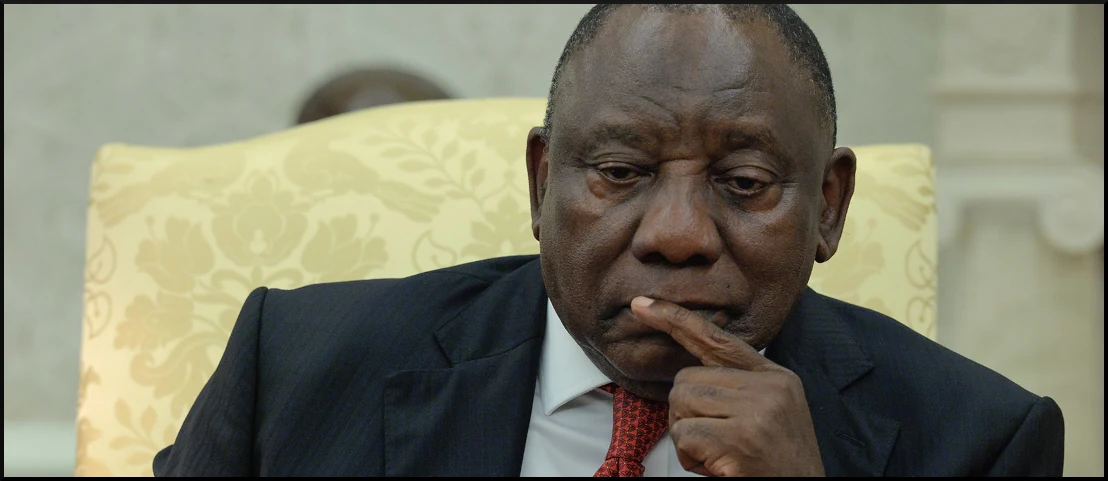
*Featured Image: WASHINGTON, DC – MAY 21: South Africa President Cyril Ramaphosa listens to a video being played by U.S. President Donald Trump during a press availability in the Oval Office at the White House on May 21, 2025 in Washington, DC. Relations between the two countries have been strained since Trump signed an executive order in February that claimed white South Africans are the victims of government land confiscation and race-based “genocide,” while admitting some of those Afrikaners as refugees to the United States. Trump also halted all foreign aid to South Africa and expelled the country’s Ambassador to the U.S., Ebrahim Rasool. Source: Photo by Chip Somodevilla/Getty Images
Mia Swart is a visiting professor in the School of Law at the University of the Witwatersrand, in Johannesburg, South Africa.