by Vijay Prashad, published on Socialist Action, December 31, 1025
The United States had no problem with Venezuela itself, nor with the country or its former oligarchy. The problem the U.S. government and its business class have is with the process initiated by President Hugo Chávez’s first administration. In 2001, Chávez’s Bolivarian process passed a law called the Organic Hydrocarbons Law, which affirmed state ownership of all oil and gas reserves, reserved exploration and extraction activities for state-controlled companies, but allowed private companies, including foreign ones, to participate in refining and sales. Venezuela, which has the world’s largest oil reserves, had already nationalized its oil through legislation in 1943 and again in 1975.
However, in the 1990s, as part of the neoliberal reforms promoted by the International Monetary Fund (IMF) and by large US oil companies, the oil industry was substantially privatized. When Chávez enacted the new law, the state regained control of the oil industry (whose oil sales abroad accounted for 80% of the country’s foreign income). This deeply angered US oil companies, particularly ExxonMobil and Chevron, which pressured the administration of US President George W. Bush to take action against Chávez. The United States attempted to orchestrate a coup to overthrow Chávez in 2002, which lasted only a few days, and then pressured the corrupt management of the Venezuelan state oil company to initiate a strike in order to damage the Venezuelan economy (ultimately, it was the workers who defended the company and wrested control from management).
Chávez withstood both the coup attempt and the strike because he enjoyed widespread popular support. María Corina Machado, who would later be awarded the Nobel Peace Prize in 2005, created a group called Sumate (“Join Us”), which called for a recall referendum. Around 70% of registered voters went to the polls in 2004, and a large majority (59%) voted to keep Chávez as president. But neither Machado nor her American backers (including the oil companies) were satisfied. From 2001 to the present, they have tried to overthrow the Bolivarian process in order to effectively return power to the American oil companies. The issue of Venezuela, then, has less to do with “democracy” (an overused word that is losing its meaning), than with the international class struggle between the right of the Venezuelan people to freely control their oil and gas and the right of US oil companies to dominate Venezuelan natural resources.
The Bolivarian process When Hugo Chávez appeared on the political scene in the 1990s, he captured the imagination of most of the Venezuelan people, particularly the working class and peasantry. The decade was marked by the dramatic betrayals of presidents who promised to protect the oil-rich country from IMF-imposed austerity and then adopted those very same IMF proposals. It didn’t matter whether they were social democrats (like Carlos Andrés Pérez of Democratic Action, president from 1989 to 1993) or conservatives (like Rafael Caldera of the Christian Democrats, president from 1994 to 1999). Hypocrisy and betrayal defined the political world, while high levels of inequality (with a Gini coefficient of 48.0) gripped society.
Chávez’s mandate (who won the elections with 56% of the vote compared to 39% for the candidate of the old parties) was a challenge to this hypocrisy and betrayal. Chávez and the Bolivarian process benefited from the fact that oil prices remained high from 1999 (when he took office) until 2013 (when he died at the young age of 58). After gaining control of oil revenues, Chávez allocated them to achieve phenomenal social progress. First, he developed a series of massive social programs (missions) that redirected oil income to meet basic human needs, such as primary healthcare (Misión Barrio Adentro), literacy and secondary education for the working class and peasantry (Misión Robinson, Misión Ribas, and Misión Sucre), food sovereignty (Misión Mercal and later PDVAL), and housing (Gran Misión Vivienda). The state was reformed as a vehicle for social justice, not as an instrument to exclude the working class and peasantry from the benefits of the market. As these reforms progressed, the government began to build popular power through participatory mechanisms such as communes. These communes emerged first from consultative popular assemblies (communal councils) and then became popular bodies for controlling public funds, planning local development, creating communal banks, and forming local cooperative enterprises (social production enterprises). The communes represent one of the most ambitious contributions of the Bolivarian process: an effort— unequal but historically significant—to build popular power as a lasting alternative to oligarchic rule.
The hybrid war imposed by the United States on Venezuela In 2013–2014, two events profoundly threatened the Bolivarian process: first, the untimely death of Hugo Chávez, undoubtedly the driving force behind the revolutionary energy, and second, the slow and then steady collapse of oil revenues. Chávez was succeeded as president by former foreign minister and union leader Nicolás Maduro, who attempted to steer the ship back on course but faced a serious challenge when oil prices, which had peaked in June 2014 at approximately $108 per barrel, plummeted in 2015 (below $50) and then again in January 2016 (below $30). For Venezuela, which depended on oil exports, this collapse was catastrophic.
The Bolivarian process failed to address the oil-dependent redistribution of wealth (not only within the country but also in the region, including through PetroCaribe); it remained trapped by its reliance on oil exports and, consequently, by the contradictions of being a rentier state. Similarly, the Bolivarian process had not expropriated the wealth of the ruling classes, who continued to wield significant influence over the economy and society, thus preventing a complete transition to a socialist project. Before 2013, the United States, its European allies, and Latin American oligarchic forces had already forged their weapons for a hybrid war against Venezuela. After Chávez won his first election in December 1998 and before he took office the following year, Venezuela experienced a rapid capital flight as the Venezuelan oligarchy moved its wealth to Miami. During the attempted coup and the oil blockade, there were further signs of capital flight, which weakened Venezuela’s monetary stability. The United States government began laying the diplomatic groundwork for isolating Venezuela, characterizing the government as a problem and building an international coalition against it. This led, in 2006, to restrictions on Venezuela’s access to international credit markets. Credit rating agencies, investment banks, and multilateral institutions steadily increased borrowing costs, making refinancing difficult long before the United States imposed formal sanctions on Venezuela.
Following Chávez’s death and the drop in oil prices, the United States launched a hybrid war against Venezuela. Hybrid warfare refers to the coordinated use of economic coercion, financial strangulation, information warfare, legal manipulation, diplomatic isolation, and targeted violence, deployed to destabilize and reverse sovereign political projects without resorting to a full-scale invasion. Its objective is not territorial conquest, but political subjugation: to discipline states that attempt redistribution, nationalization, or an independent foreign policy. Hybrid warfare operates through the militarization of everyday life. Monetary attacks, sanctions, shortages, media narratives, NGO pressure, legal harassment (lawfare), and manufactured crises of legitimacy are all designed to erode state capacity, deplete popular support, and fracture social cohesion.
The resulting suffering is then presented as evidence of internal failure, masking the external architecture of coercion. This is precisely what Venezuela has faced since the United States illegally imposed financial sanctions on the country in August 2017, deepened them with secondary sanctions in 2018, disrupted all payment systems and trade channels, and enforced excessive compliance with US regulations. Media narratives in the West systematically downplayed the sanctions while amplifying inflation, shortages, and migration as purely internal phenomena, reinforcing the discourse of regime change. The collapse of living standards in Venezuela between 2014 and 2017 cannot be separated from this multifaceted strategy of economic strangulation.
Mercenary attacks, sabotage of the electrical grid, the creation of a conflict between Guyana and Venezuela to benefit ExxonMobil, the invention of an alternative president (Juan Guaidó), the awarding of the Nobel Peace Prize to someone who calls for war against his own country (Machado), the attempted assassination of the president, the bombing of fishing boats off the Venezuelan coast, the seizure of oil tankers leaving Venezuela, and the buildup of a navy off the country’s coast: each of these elements is designed to create neurological tension within Venezuela that will lead to the surrender of the Bolivarian process in favor of a return to 1998 and, subsequently, to the annulment of any hydrocarbon law that promises the country’s sovereignty.
If the country were to revert to 1998, as María Corina Machado promises, all the democratic gains achieved through the social missions and communes, as well as the 1999 Constitution, would be nullified. In fact, Machado said that a US bombing campaign against her fellow Venezuelans would be “an act of love.” The motto of those who want to overthrow the government is “Onward to the past.” In October 2025, meanwhile, Maduro told an audience in Caracas in English: “Listen to me, no to war, yes to peace, people of the United States.” That night, in a radio address, he warned: “No to regime change, which reminds us so much of the endless, failed wars in Afghanistan, Iraq, Libya, and so on. No to coups orchestrated by the CIA.” The phrase “no to war, yes to peace” spread on social media and was remixed into songs. Maduro appeared several times at rallies and meetings with loud music, singing “no to war, yes to peace,” and on at least one occasion, wearing a hat with that message.
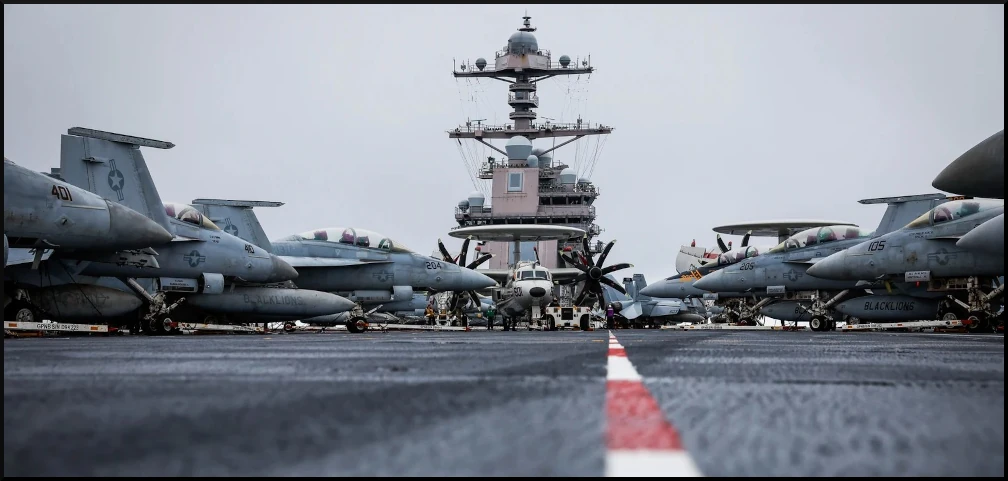
*Featured Image: Aircraft transported on the US aircraft carrier USS Gerald R. Ford. Photo: EFE.]
Vijay Prashad, an Indian author, journalist, political commentator, and Marxist. Prashad is the executive-director of Tricontinental: Institute for Social Research, editor of LeftWord Books, and Chief Correspondent at Globetrotter