from the News Desk @theCradle, published on Popular Resistance, October 24, 2025
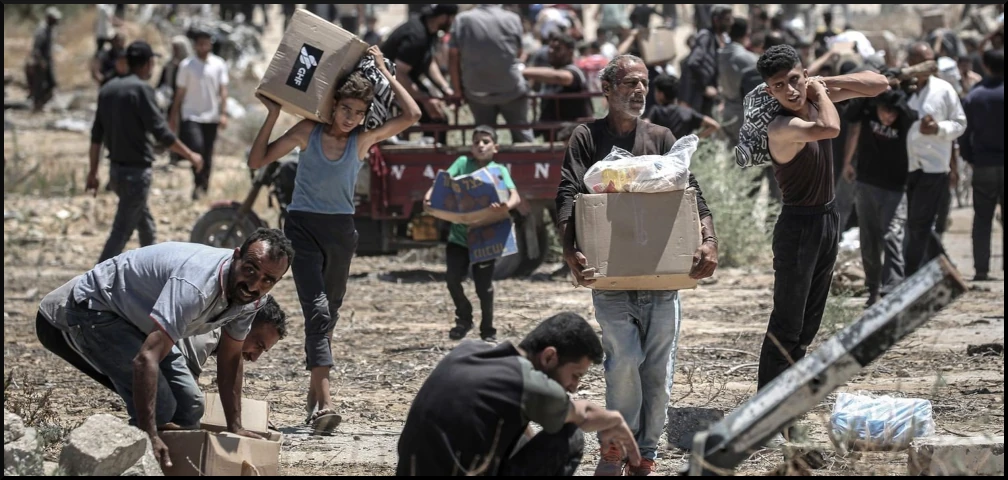
At least 1,000 Palestinians seeking food from GHF sites in Gaza were shot and killed by Israeli troops.
The Gaza Humanitarian Foundation (GHF), a deadly aid scheme operating in the Gaza Strip, is in talks with US and Israeli officials about a potential new post-war role in the enclave, the Financial Times (FT) reported on 23 October.
The US and Israeli-created GHF began operations in May, but the amount of aid it distributed was negligible for Gaza’s roughly 2 million people, aid groups and some Israeli officials have said.
At the same time, Israel sought to cut off aid distribution from the UN and international humanitarian groups in Gaza as part of its effort to starve Palestinians and force them to move to the southern region of the strip.
At least 1,000 Palestinians were killed by live fire from Israeli troops while seeking food from GHF sites, which have been described as “death traps.”
The GHF stopped operations in the strip after the ceasefire was reached in Gaza earlier this month. The distribution of humanitarian aid to the starving Palestinian population is once again being led by the UN.
But the GHF is now lobbying for a role in post-war Gaza, four people familiar with the matter told FT.
US-Israeli businessman and GHF founder Michael Eisenberg is in discussions with senior US military officers and officials at the Civil-Military Coordination Center (CMCC), a multinational body established by US President Donald Trump to monitor the ceasefire between Hamas and Israel.
According to Hebrew media reports, Eisenberg will be appointed as Israeli Prime Minister Benjamin Netanyahu’s personal representative to the CMMC.
The GHF is proposing that it continue its role of operating food distribution centers in Gaza territory still under Israeli military control, managing logistics hubs for reconstruction, or supplying aid to other foreign aid groups.
The foundation is seeking to continue, but “under a different cover,” sources familiar with Gaza humanitarian issues told FT.
The “founders are on to bigger and better things, and bigger and better deals,” the sources added.
“In principle, they’re supposed to be done, but the people behind GHF are poking around … telling [US officials] how successful it was,” said one former senior Israeli official.
Salim, a 19-year-old Palestinian displaced to a tent with his family in the so-called Al-Mawasi safe zone on the Gaza coast, told FT he was happy the GHF had ceased operations.
“It was humiliating, but we were forced to go because there was no food to buy and we had little money. If they reopen, I won’t go again,” he said.
*Featured Image: Ahmad Salem/Bloomberg/Getty Images.