by Dee Knight, Shanghai, September 4, 2025
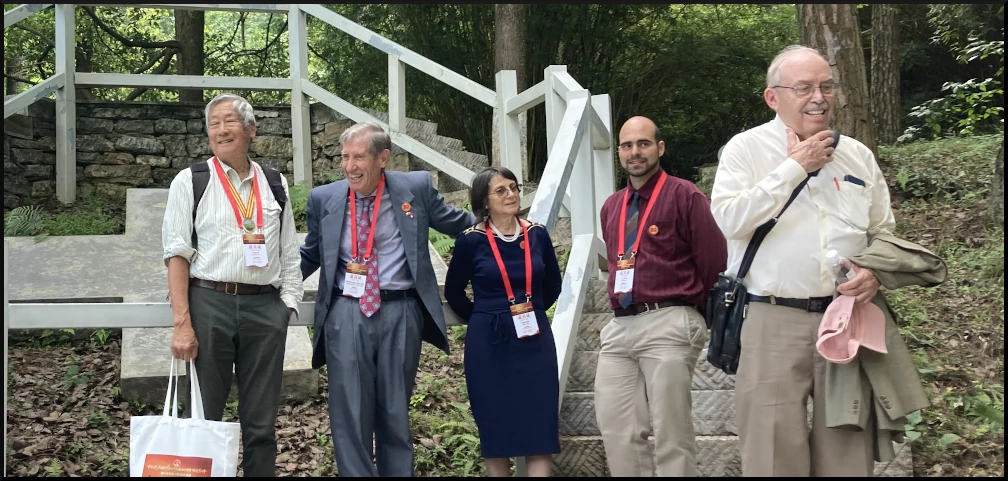
*Featured Image: International delegates to a commemoration of the 80th Anniversary of the Chinese Victory Against Fascism, in Guiyang, capital of Guizhou province in SW China. Dee Knight is on the right. Photo by Judy Bello
Beijing buzzed with excitement last weekend as leaders of friendly countries poured into Beijing from around the world. They came to celebrate China’s 80th anniversary of defeating Japanese fascism in World War II, and to participate in the Shanghai Cooperation Organization’s Summit meeting. It was an impressive display of “unity in multi-polarity” featuring Russian President Putin and Indian Prime Minister Modi, as well as North Korean leader Kim Jong Un, among about two dozen others.
With participation of most southeast Asian members of ASEAN, as well as the “stans” of central Asia, China was literally surrounded by friendly representatives of the world majority – countries representing well over four billion people and nearly half the world economy. Another prominent participant was President Pezeshkian of Iran, which maintains close economic and military partnerships with both Russia and China.
The New York Times called Beijing’s Victory Day parade on September 3 “a defiant warning to its rivals.” The awesome display of China’s military might at the V-Day parade lent “a menacing tone” for Western leaders and media. CNBC said Xi Jinping made “a thinly-veiled swipe at Trump’s global tariff campaign” when he said “shadows of Cold War mentality and bullying have not dissipated, with new challenges mounting.”
CNN offered a more measured tone, quoting Xi that “I look forward to working with all countries for a more just and equitable global governance system… We should continue to dismantle walls, not erect them; seek integration, not decoupling.” CNN added that “Xi’s vision pushes back against the foundations of a US-led world order, opposing alliances like NATO.”
Russian President Putin commented to Russian media after the summit that “The SCO is not designed to confront anyone. We do not set ourselves such a task. And… during the discussions and bilateral meetings, there has never been anything that could be described as a confrontational beginning during these four days.”
In kicking off the SCO Summit, Xi said “We should advocate an equal and orderly multipolar world, and a universally beneficial and inclusive economic globalization, and make the global governance system more just and equitable.”
How defiant is that? (But advocating “universally beneficial and inclusive economic organization” can actually be considered a death threat for the US-led “rules-based” system.)
The massive military display at Beijing’s V-Day celebration left little doubt that China would never allow itself to be bullied again. More than 35 million Chinese were killed in Imperial Japan’s invasion and occupation of their country from the early 1930s to the end of World War II in August 1945. That’s even greater than the USSR’s loss of 27 million from the German Nazi onslaught. Together those numbers prompted Trump to say “Many Americans died in China’s quest for victory and glory. I hope they are rightfully honored…”
The “American Century”
The US lost about 420,000 soldiers in World War 2, according to the National WW2 Museum. But it assumed the role of overall victor, launching “the American Century” along with a global war against communism. It has maintained occupation troops in Japan, South Korea, the Philippines, Guam and other Pacific islands – all of which are deployed today against China, just as NATO (its “defensive alliance” against the Soviet Union) continues to threaten Russia. Which side is threatening and destabilizing? It depends largely on your point of view.
During the Korean War, from 1950 to ’53, the US killed millions of Koreans, and flattened all buildings of more than one story, in a massive bombing campaign. Its threats to extend the war into China were repelled by the mobilization of half a million Chinese to fight alongside the North Koreans. The US war against Vietnam began shortly after the French colonizers were defeated in 1954, and lasted until the US was finally defeated in 1975, at a cost of additional millions of Vietnamese victims and tens of thousands of US troops. Both wars were also aimed at China, and China provided troops and weapons in both, to support their allies.
The war zones of today, in eastern Europe, West Asia and the Far East, are continuations of eighty years of US global domination, both militarily and economically. But the way the US is protecting its interests in all three areas has exposed a blunt reality: the constant official refrain that “America is protecting democracy and human rights” is nothing but war propaganda.
The US: Sponsor and Protector of Fascists
While China and the USSR achieved major defeats against fascism, the US sheltered and rehabilitated Imperial Japan’s fascist rulers, helping them form and maintain the country’s far-right Liberal Democratic Party which has ruled virtually non-stop for 80 years. (The US CIA did the same for the fascists of Ukraine, and have since sponsored them against Russia.) Japan’s rulers have always refused to apologize for slaughtering millions in their invasion and occupation of China. Ditto for Japan’s 35-year colonial hold on Korea, from 1910 to 1945. In both countries the Japanese imperialists became notorious for setting up systems of “comfort women” – really sex slaves for Japan’s occupation forces (not very different from the hospitality enjoyed by US occupation forces across Asia today, but a significant contrast to the status of women in China today).
The US has sponsored continual military dictatorships in South Korea, which were always aimed at threatening China, most notably in the so-called Korean War, that ended in armistice in 1953, but has continued ever since then without a peace treaty. Instead the US imposed a different treaty on its South Korean client, guaranteeing “operational control” of the massive Korean military in case of war against either the Democratic People’s Republic of [north] Korea (DPRK), or against China, or both. That underscores the significance of DPRK leader Kim standing next to Russian President Putin and Chinese President Xi at the V-Day event.
South Korea’s new President Lee Jae Myung came to power last June, following six months of intense popular struggle to oust the US puppet President Yoon, who was impeached and jailed after declaring martial law, and trying to provoke a war with US backing. When President Lee visited Trump in August, he resisted US pressure for him to join US escalation against China, which is South Korea’s number one trading partner.
The friendly leaders from around the world who showed up at both the SCO summit and the Beijing V-Day celebration showed that US efforts to surround and threaten China are failing. Most of the southeast Asian countries that make up ASEAN, notably Vietnam, Indonesia, Laos, Malaysia, Myanmar, Thailand, and Cambodia, attended after recent visits to their countries by Chinese President Xi. The significant exception was the Philippines, where the US maintains a military alliance aimed at China. But like in South Korea, the popular movement against US domination is strong, with serious efforts to force the US bases out, and to help US soldiers to refuse to engage in a hopeless war that can only lead to needless suffering and death.
Remembering When the US Helped China Against Fascism
The week before China’s national V-Day celebrations, there was a special celebration in the southwestern province of Guizhou, honoring doctors and nurses from the US and European countries who formed an International Medical Rescue Corps. A Xinhua report said “Dozens of foreign medical workers worked alongside thousands of their Chinese counterparts from the Chinese Red Cross Medical Relief Corps to save lives and provide medical training under harsh conditions. Today, these foreign medical workers are collectively remembered as the International Medical Relief Corps (IMRC).”
On August 26, a delegation of the descendants of these volunteers attended a commemoration in Guiyang, the capital of Guizhou province, “to pay tribute to their forebears and mark the 80th anniversary of the victory in the Chinese People’s War of Resistance Against Japanese Aggression and the World Anti-Fascist War,” the Xinhua report said.
“As descendants of the International Medical Relief Corps, we are incredibly grateful to you for keeping our ancestors’ memory alive,” said Peter Soyogyi, whose father served in the IMRC. “For them, as international anti-fascists, this was not just China’s war; it was their own. It is essential for future generations to understand the fight against fascism and the struggle for freedom,” he added.
Following the commemoration ceremony, the descendants’ delegation and a group of solidarity activists from the US traveled along the famous “24-Zig Road” – also known as the Stilwell Road – which served as a supply line from Burma (now Myanmar) and India for medical supplies to the US-supported Chinese resistance to Imperial Japanese aggression. The road was a joint project of US and Chinese forces, and a symbol of their united efforts against Japanese fascist forces at the time.
US commanding General Joseph Stilwell had many conflicts with Chinese Kuomintang (KMT) leader Chiang Kai-Shek, who called for his ouster. Stilwell argued for unified efforts of the KMT and Red Army forces, which led to his replacement.
The descendants’ delegation, and the solidarity group from the US, got a close-up view of the challenges faced by US troops, as well as US and European medical workers, in helping the Chinese resistance to fascism during World War II.
Official US support during World War II for Chinese resistance to fascism was a major factor in defeating global fascism. But the switch to supporting fascism after the war, including up to the present day, poses a challenge to the world’s progressive forces. The existence of the Shanghai Cooperation Organization constitutes a giant bulwark in that fight. But the struggle continues, as challenging as ever, as can be seen in the US-backed genocidal assault on Palestine. Just as the world’s progressive forces united to stop fascism in the 1940s, history calls on us to unite even more strongly today. Victory against fascism today will spell the end of imperialism and capitalism, and usher in the common prosperity and shared future the world needs now.
* * *
Dee Knight is the author of Befriending China: People-to-People Peacemaking, and A Realistic Path to Peace. He serves on the Advisory Council of Friends of Socialist China, and on the China Working Group of DSA’s International Committee. For more information, see https://DeeKnight.blog.