by Syd Locke and Jessica Ryan, September 18, 2025
After spending three weeks traveling to many parts of China with DSA members and other leftists, we came away with invaluable first-hand experience of China’s transformation, deepened our historical knowledge of China and, most importantly, came away with a keen awareness of our responsibilities as socialists, as internationalists, to build relationships with the people of China and to fight against war — whether it be a trade war, a cold war, or a disastrous hot war that the Pentagon has been planning for years.
Our first stop on our trip was Guiyang, the capital city of the Guizhou Province. Due to the rugged nature of this land-locked, mountainous province, it was the last area of China where the government was able to lift people out of absolute poverty. Throughout China, an astounding 800 million people were lifted out of poverty and now have access to plentiful food, housing, healthcare, education and economic opportunity. Think about that for a moment; 800 million people out of poverty! That is one of the great accomplishments in world history. State-directed investment built world-class infrastructure and transformed an isolated, land-locked poor province into a thriving economic hub. There is a saying in China: if you want prosperity, first build a road. The roads and bridges in Guizhou were the best we’ve ever seen and are a stark contrast to the deteriorating infrastructure in the US.
As we know, socialism is not an equal sharing of poverty. China has gone through various stages over the decades and has built up the economic productive forces to where she can amply provide for her people. Guizhou Province is an example and it was great to see it firsthand. We heard remarkable stories, including the story of Mr. Wang, who as a boy had to walk three hours to school and carry a bag of rice on his back to last him all week until he walked home on the weekends. Roads, bridges, hospitals and schools have been built and life has been transformed. Now Mr. Wang is multi-lingual and helps with economic development projects.
And things keep getting better: China has been quickly evolving away from the go-go 1990’s and early 2000’s, to an economy that is more sustainable. In fact, China is by far the world leader in producing renewable energy. We saw many windmills and thousands of solar panels on hillsides and deserts while traveling the countryside. The streets were full of electric scooters, taxis and buses. China’s goal is to hit peak emissions by 2030 and be carbon-neutral by 2060. Actually, emissions are estimated to have fallen by over 2% so far this year and many experts are saying that China’s emissions have already peaked — well ahead of their 2030 goal. Meanwhile, the US emissions are up over 4% and are trending in the wrong direction. We also saw parts of the “Great Green Wall”, which is a project to reverse desertification in regions in China. In the 1980’s there were missteps but since then, after learning from their mistakes and applying the latest environmental techniques, they are seeing results. The job will become more difficult as climate change increases global temperatures, but they are committed to keep working, learning and finding ways to succeed.
The CPC is also putting more emphasis on reducing income inequality. It’s not just about raw growth in GDP. We think there is a reason to be confident that they will reach their development goals because in China, unlike in the US, the government is not controlled by the capitalist class. The number of billionaires has been falling and corruption has been harshly prosecuted. The “commanding heights” of the economy, such as banking, energy, heavy industry, telecommunications, and transportation are state-owned enterprises. China has been successfully walking the tightrope of attracting capital, building up the productive forces, and keeping the capitalist class subordinate.
Of course, there are people in China who have political differences and disagree. It’s a country of 1.4 billion people after all. We met with professors at a Marxist Party School in Guiyang, and one of the older professors strongly believed in emphasizing the market over the direction of the Party, whereas a younger professor believed that the CPC was navigating things about right. Later, when we visited Beijing, we met with a professor, activists, and students who describe themselves as “Maoists” — and while conceding that no other country has done better than China in meeting the needs of the people over the past 75 years, they think that the CPC is too capitalistic and needs more state control.
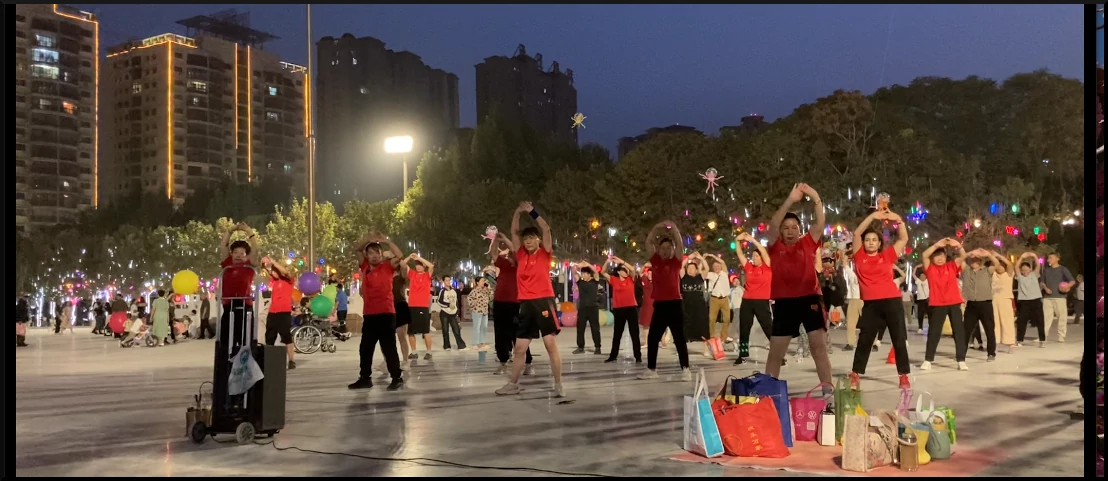
We also traveled to Xinjiang, formally known as the Xinjiang Uyghur Autonomous Region. We know some people in the West, whether they are on the left or the right of the political spectrum, are committed to the idea that there is a Uyghur genocide going on. We wanted to see for ourselves. Did we see any evidence of genocide? Did we see any evidence of cultural suppression? Did we see signs of fear? What we saw were bustling Uyghur markets, urban and rural. We saw tourist attractions and many visitors. We spent a morning at a large and modern Uyghur history and cultural museum. We stopped to take photos of two large mosques. We saw street signs and other governmental signs in multiple languages, so Uyghurs and other minorities have full access to what’s going on in society. We actually danced with Uyghur people in plazas on three separate occasions, once in Kashgar, and twice in Hotan. We know that some people in the west are dug in on their opinions that there is an ongoing genocide in Xinjiang. We have our doubts. If there is one, it is accompanied by a lot of dancing!
We went out to agricultural areas, including cotton farms, where we learned that modern farm equipment was utilized and that the farm labor force was minimal. And yes, it was paid labor. There are still people in China who live modest lives with modest incomes, but the social safety net is better than in the US. We met a woman who was retired and traveling at age 51! Women can retire at 50 and men at 60, although with longer life expectancy the government will be slightly, and gradually, ratcheting that up over the next 15 years.
We did experience heightened security in Xinjiang, with people having to show identification and go through metal detectors when entering certain enclosed public spaces where large crowds gather. But most of the police were unarmed. Keep in mind that the United States incarcerates people at a rate that is over three times the rate that China does.
There were a few sightings of military personnel; we both were looking for them on this trip. We also noticed that no one was looking uncomfortable or scared when police were around. The police were composed of many women and ethnic minorities. In Hotan, we saw a policeman stop by an outdoor basketball court and chat and chuckle with the players for a few minutes. Before he left, the players tossed him the ball to hoist up a couple shots.
The people of Xinjiang largely support the security measures. Xinjiang comprises 1/6th of China’s territory and an even larger percentage of its border. It is a key to China’s Belt and Road Initiative and has been an important trade route since the days of the ancient Silk Road. There have been separatist groups and jihadists that have committed terrorist acts in Xinjiang, and the US has been supportive of them through CIA operations and “CIA cutout” organizations like the National Endowment for Democracy (NED). The US has surrounded China with hundreds of military bases and would like to disrupt travel and commerce through both land and sea. Frankly, the US would like to break up China and reduce them to a subordinate of the US empire. China is committed to its territorial integrity and is highly sensitive to foreign interference.
We think some of the best things the US left can do is to work to end sanctions, dismantle US foreign bases, curb and eventually abolish the CIA, and respect the sovereignty of all nations. We need to build friendships, not march into another war. We hope more people will take the opportunity to travel to China and build friendships.
Don’t necessarily swallow western accounts of what is happening in China – even by human rights organizations. Look closely at their sources. Those organizations are under pressure not to make the West look bad. Remember, it took western human rights organizations over 14 months to finally say that there is a genocide in Gaza! They had to say something to salvage the last remnants of their organizational credibility.
As history has shown, as Gaza is showing us daily, the US is not concerned with Muslim lives. The US empire is not concerned with the flourishing of all countries. They don’t want us to see a successful example of a country that is building a socialist project. The US empire wants domination and control. It’s up to us in the “Belly of the Beast” to organize and fight back.
Syd and Jessica are active members of Democratic Socialists of America who strongly believe in working towards a world of peace and tolerance. They returned a few days before writing this piece from a weeks long visit to China, to see for themselves what life is like for the people there. They were especially interested in visiting Xinjiang because they had heard conflicting stories about China’s treatment of the Uyghur muslems living in that region.
Thank you Syd and Jessica. Excellent read and great to hear about things first hand from good friends. We all need fresh insights into our cohabitants of this planet.